
Last updated October 31, 2026
 Home additions & ADU
 Kitchen remodeling
 Bathroom remodeling
 Roofing
 Windows & doors
 Driveway & pavers
 Fence
Free written scope consultation - allowances, timeline, and change-order rules on paper before a single trade is scheduled
Construction Warning Signs: A Milpitas Homeowner’s Reference Guide
A diagonal crack running from the corner of a door frame is not a drywall problem. It is a foundation movement indicator, and in Milpitas, where the soil shifts with every wet winter and dry summer, that crack can mean differential settlement that a patch-and-paint job will hide for exactly one season before it returns larger. Most homeowners treat the symptom. This guide teaches you to trace it. You will learn how to read your Milpitas house the way a general contractor does: starting at the visible sign, then working backward to the system that actually failed. We will cover stucco fractures, door misalignment, efflorescence, ceiling stains, attic observations, documentation protocol, and the specific ways Milpitas clay soil behaves under the concrete slab you are standing on right now.
Quick Answer
Construction warning signs in a Milpitas home are visible symptoms of a failing system, not standalone problems. Cracks, stains, sticking doors, and white mineral deposits each trace back to a root cause: foundation movement, roof leaks, drainage failure, or material incompatibility. Treating the symptom without diagnosing the source delays repair, increases cost, and can create disclosure problems when you sell—one reason many homeowners weigh DIY vs Professional Construction: The Milpitas Homeowner’s Decision Guide before starting.
Styles & brands we work with
Table of Contents
- The Root-Cause Map: What Your House Is Actually Telling You
- Why Milpitas Soil Makes Foundation Reading Different
- Stucco Cracks: Cosmetic, Seasonal, or Structural?
- Door and Window Misalignment: The First Honest Indicator
- Efflorescence: The White Powder That Means Water Is Moving
- Ceiling Stains and Attic Clues You Can Safely Check
- The Documentation Protocol: Protecting Yourself Before, During, and After
- Cosmetic Workmanship vs. Structural Failure: How to Tell Them Apart
The Root-Cause Map: What Your House Is Actually Telling You
Every home is a system of interconnected assemblies. The roof sheds water. The walls transfer load. The foundation distributes weight into the soil. The windows and doors are the moving parts between all of them. When one assembly fails, it almost always announces itself somewhere else. That is why the crack above the bedroom door is rarely about the drywall. The drywall is just the messenger.
In Milpitas, we see the same five or six root causes recurring across nearly every neighborhood: expansive clay soil movement, drainage failure, roof flashing failures, aging window seals, and material incompatibility. The visible warning signs are how those failures surface. Before you call a drywall contractor to fix the crack, trace the line. Here is the map we use on every assessment, and the one you can use before you even pick up a phone.
- Diagonal crack from a door or window corner: the opening is acting as a stress riser, and the wall is flexing. Root cause is usually foundation movement or inadequate header support, not the drywall.
- Horizontal crack low in a garage or retaining wall: lateral soil pressure. In Milpitas, this is often tied to irrigation overspray or a drainage downspout emptying too close to the wall.
- Stair-step cracks in stucco following mortar joints: recurring expansion and contraction cycles, but the pattern and width tell you whether it is seasonal cycling or progressive settlement. More on this below.
- White chalky residue on concrete or masonry: efflorescence. Water is dissolving salts inside the material and depositing them on the surface. That water is the problem, not the powder.
- Door that catches only during certain months: seasonal humidity cycling, or the slab edge heaving. Note the season and the humidity level each time.
- Ceiling stain with brown rings or a musty note: active or recurring roof leak, or condensation in an unvented attic. The stain is a calendar of how many times water has made the trip.
Our Milpitas Construction home assessment process always starts with the same question: what changed recently, and what has been changing for years? A crack that appeared in one week after heavy rain tells a completely different story than a crack that has widened a quarter-inch over nine years.
Why Milpitas Soil Makes Foundation Reading Different
Milpitas sits on alluvial deposits laid down by creeks draining the Diablo Range into the bay flatlands, and much of the residential land includes expansive clay. Expansive clay is not a subtle material. It swells when wet and shrinks when dry, and it does both with a surprising amount of force. A concrete slab or stem wall foundation sitting on that soil moves with it. The movement is slow, seasonal, and largely predictable to a trained eye. The problem is that most homeowners do not know what they are looking at.
What we see across Milpitas is a pattern of seasonal crack cycling. Cracks open during the dry late-summer and early-fall months, then partially close during the winter rains. If you watch a crack over a full year and it returns to nearly the same width every spring, the foundation is breathing normally. That is not typically an emergency. If the crack widens net over two consecutive dry seasons and does not close during the wet months, the soil is not rebounding, and you are likely looking at progressive settlement. That distinction is the single most useful diagnosis a Milpitas homeowner can make, and it costs nothing but attention.
There are also location-specific variables. Homes near creek channels, including neighborhoods along Berryessa Creek or Calera Creek, sit on soil with a higher organic content and a different drainage profile than homes on the higher flats. Homes built on cut-and-fill lots are particularly prone to differential settlement, because the fill side of the lot settles at a different rate than the cut side. If your Milpitas home was built on a fill pad, a door that sticks on one side of the house but not the other is a classic differential sign, not a hinge problem. A full General Contractor in Milpitas evaluation will map the lot history, drainage, and crack patterns together, because those three pieces of information tell one story.
Stucco Cracks: Cosmetic, Seasonal, or Structural?
Stucco is the default exterior finish for a large share of Milpitas homes, and it is also the most honest cladding material on the market. Stucco does not hide movement. It cracks, and the crack pattern tells you where the frame or foundation is moving and in what direction. The key is reading the shape, width, and location together.
Hairline cracks, generally less than 1/16 inch wide, that run in random directions and do not track the mortar joints, are usually cosmetic shrinkage from the original curing process or from thermal expansion. Those are normal. You can monitor them without panic. The ones that deserve your attention are the stair-step cracks that follow the mortar joints in a diagonal line across the wall. That pattern means the wall is shearing, and in most cases, the force is coming from below: slab edge movement or a settling corner of the foundation.
Crack classification for Milpitas homeowners:
- Measure the width. Use a dime. If the crack is narrower than the thickness of a dime, it is classified as minor for now. If a dime drops into the crack, document it and monitor monthly.
- Note the pattern. Straight vertical cracks near corners are often expansion-related. Diagonal stair-step cracks following joints suggest shear movement. Horizontal cracks below grade on a retaining wall suggest soil pressure.
- Track the season. Mark the crack end with a pencil line and date. Check it every 6 to 8 weeks. If it extends past the line during the dry season and does not close during the rain, call for a professional assessment.
- Check both sides. Exterior stucco cracks often correspond to interior drywall cracks at the same wall. If both exist and align, the movement is passing through the wall, which is more serious than either crack alone.
We have performed Home Remodeling in Milpitas projects where the original stucco crack was patched by a handyman three different times, and each time, the crack returned before the end of the dry season. The fix was not another patch. It was re-grading the drainage on the uphill side of the foundation to stop the wet-season swell from concentrating under one corner. The crack has not returned since.
Door and Window Misalignment: The First Honest Indicator
Before drywall cracks appear, before stucco tells the story outside, doors and windows usually know something is wrong. They are the only moving assemblies in the structural envelope, and they have tight tolerances. When a slab heaves or a corner settles, the frame racking shows up first as a door that rubs, a latch that no longer lines up with the strike plate, or a window that suddenly requires force to open and close.
The most useful distinction here is between seasonal and progressive misalignment. Seasonal misalignment follows the Milpitas wet-dry cycle. A door drags at the top corner during the late summer, then releases during the winter. That is the clay expanding and contracting. It may be annoying, but it is not a failure. You can plane the door, adjust the hinge, and move on. Progressive misalignment does not release. The door rubs harder each month regardless of the season, and the gap at the top of the door frame grows while the gap at the bottom shrinks. That is the house settling, and it will not stop on its own.
There is also the window-specific sign that Milpitas homeowners miss: gap symmetry. Look at the reveal, the gap between the window sash and the frame, on all four sides. If the reveal is even on the left and right but pinched at the top, the header is deflecting under load. If the reveal is pinched on one side only, the wall is racking. Both are structural conversations. We have used PGT window systems on several Milpitas replacements where the original windows had been forced into the frames so hard the glass seals broke, and the homeowners thought they just needed new windows. The windows were a symptom. The wall needed to be addressed first.
When a full wall keeps racking, no window replacement solves it. We do not sell homeowners a product that will fail in the same frame the old one failed in. We read the frame first. Any Home Renovation in Milpitas project that involves windows and doors should begin with a frame and foundation read, because replacing the smooth-moving parts of a house onto a moving frame is a losing sequence.
Efflorescence: The White Powder That Means Water Is Moving
Efflorescence is the white, chalky, sometimes crystalline deposit that appears on concrete, brick, stucco, and masonry. It is not mold, and it is not typically dangerous by itself, but it is one of the most reliable water-movement indicators a house can give you. Efflorescence forms when water enters masonry, dissolves salts inside the material, carries them to the surface, and then evaporates, leaving the salts behind. The powder is the residue of a transportation system, and the active ingredient is water.
In Milpitas, efflorescence shows up in predictable places: the lower 18 inches of a stucco wall that receives overspray from sprinklers, the interior face of a retaining wall where the backfill drains poorly, the stem wall of a raised foundation where a downspout empties too close, and garage slabs where a water heater condensate line or an irrigation leak runs under the slab edge. Each location points to a different source, and the location matters more than the powder itself.
- Interior of a retaining wall: drainable backfill is missing or clogged, and hydrostatic pressure is pushing water through the wall. Continuing to ignore it leads to wall movement, not just staining.
- Exterior stucco at grade: grade is too high relative to the weep screed, or sprinkler spray is hitting the wall on a schedule. Adjust the irrigation arc first, then monitor.
- Garage slab or basement: the water is coming from below, and the source is usually a leaking supply line or a condensate line. Treated water in the soil under a slab is a slow-motion problem worth finding early.
- Chimney or fireplace face: the crown or cap is cracked and allowing rainwater in, and the salts are being drawn out through the masonry. This becomes a roof leak conversation if left too long.
One note for Milpitas homeowners: a white deposit that wipes off easily with a dry cloth is fresh and active. A deposit that has hardened into the surface suggests the water has been traveling for a while. Neither should be sealed or painted over until the water source is stopped, because sealing over efflorescence simply forces the water to find a new exit, which is often deeper into the wall cavity.
Ceiling Stains and Attic Clues You Can Safely Check
Ceiling stains are a map of water history, and most of the information they contain is visible from inside the house or from an attic access panel, not from a ladder on the roof. The color, shape, and ring pattern of a stain tells you whether a leak is active, recurring, or long dead.
A single, uniform, light-brown stain with no rings is often a one-time event: a plumbing overflow, a wind-driven rain that entered through a rare gap, or condensation from a one-off temperature extreme. That stain may not require any action beyond monitoring. A stain with multiple concentric rings, dark edges, or a yellowed center is a different story. Each ring represents a separate wetting event, and the distance between the rings can tell you the frequency of the leak. Rings close together mean the leak is chronic. A ring pattern that has spread outward over months means the leak has been active for a long time, and you need to trace it now.
The attic check, conducted safely from the access point:
- Open the attic access and look for daylight. Before you step away from the ladder, scan for any pinhole of light that does not come from a vent. Daylight means a roof penetration has a gap. This is the single best dry-day roof inspection tool a homeowner has.
- Look for dark, streaked, or blackened sheathing. The underside of the roof deck should be a uniform wood color. Dark streaks or black staining mean recurring moisture. It may be a leak, or it may be condensation from a bathroom fan vented into the attic, which is a common Milpitas issue in older homes.
- Follow the insulation lines. Compressed or discolored insulation in a line or a depression tells you water has been flowing along that path. The source is typically uphill of the stain.
- Check the vent boots and pipe penetrations. From inside the attic, the rubber boots around plumbing vents and the flashing around flues are visible. Cracked boots are the most common roof leak source we find, and they are also the cheapest to replace before the leak spreads.
The one thing we ask you not to do is walk the roof. Clay tile roofs, common in Milpitas, are easy to crack under foot traffic, and no observation is worth the fall risk or the tile damage. The attic tells us most of what we need to know, and a professional roof read should be one of the first calls in any re-roof or exterior renovation. We specify roofing systems by manufacturer, including GAF and CertainTeed assemblies, so the repair or replacement is not guesswork. A roof is not a commodity; it is a system, and the warning signs above your head deserve a system-level answer.
The Documentation Protocol: Protecting Yourself Before, During, and After
The difference between a covered warranty claim and a denied one is usually a paper trail. The difference between a smooth home sale and a disclosure dispute is usually the same thing. Most homeowners spot a warning sign, take a mental note, and move on. Months later, they cannot remember when the crack appeared, how wide it was, or whether it has grown. Memory is not documentation.
Milpitas homes change hands regularly, and California disclosure requirements put a real legal weight on what a seller knows or should have known about the condition of the property. If you notice a construction warning sign and do not document it, you still know about it. That knowledge follows you into any future sale, whether or not you wrote it down. Documentation protects both the current repair decision and the future disclosure conversation.
- Photograph with a reference object. Place a coin, a pencil, or a ruler against the crack or stain before you take the photo. A photo without a scale reference is nearly useless later. Take one wide shot for context and one close shot for detail.
- Date every photo. Do not rely on your camera roll metadata alone, because it can be stripped or lost. Write the date in a note, or use a small whiteboard in the photo.
- Log a one-sentence description. “Diagonal crack above south bedroom door, 1/8 inch at widest, extends 14 inches, appeared after January rain.” One sentence is enough, but write it while you are looking at it.
- Repeat monthly for three months, then quarterly. The first 90 days tell you whether a crack is active or stable. Quarterly photos after that give you the seasonal picture.
- Keep records with the house, not with you. If you move, the next owner should inherit the crack log. It is an asset, not a liability. Documented stable cracks are ordinary; undocumented cracks are an open question.
If you eventually engage a contractor for a repair, use our General Contractor Maintenance Checklist for Milpitas Homeowners and ask for the written scope, the product names, and the warranty terms before work starts. We have seen Milpitas homeowners try to file a stucco patch warranty claim with no record of who performed the work, when, or with what product. The claim failed. A written line-item scope with named products, from Cambria countertops to CWS window systems, is the basic protection every homeowner should insist on.
Cosmetic Workmanship vs. Structural Failure: How to Tell Them Apart
Not every construction warning sign involves the foundation or the roof. Some are simply bad workmanship: a misaligned tile line, a grout joint that cracked because the installer mixed the grout too thin, a cabinet door that was hung slightly out of square. These are cosmetic issues, and they should be handled by the contractor as part of the normal punch list or warranty. The problem is that homeowners often cannot tell the difference between a cosmetic defect and the early stage of a structural problem, and contractors sometimes exploit that uncertainty in both directions.
The basic test is whether the sign is isolated or systemic. A single cracked floor tile in the center of a room is usually a defect: a tile set over an uneven substrate, a point load dropped on it, or a poor thin-set bond. The same crack running through three adjacent tiles in a straight line is usually subfloor movement below. A hairline crack in one grout joint is cosmetic. A crack that follows the full length of the tile row and has opened the adjacent grout joints is differential movement. One door that sticks is a hinge problem. Three doors on the same side of the house that stick is a settlement problem.
Here is the practical field guide we recommend:
- Isolated, random, and stable: cosmetic or installation-defect territory. Document, monitor, and address during the next maintenance cycle.
- Repeated pattern, multiple locations, same orientation: systemic. Diagonal cracks at multiple door corners on the same elevation mean the wall plane is flexing. Do not repair the drywall until the movement is understood.
- Growing, widening, or extending over a 90-day window: active. This is the category where waiting costs more. A moving corner does not stop moving because you painted it.
- Seasonal, returns to baseline, stable width over multiple years: normal house behavior. Milpitas homes on clay will move. A house that does not move may be the exception, not the rule.
When a homeowner finds something in the systemic or active category, the next call should be to a full-scope Milpitas Construction home general contractor who can read the whole house, not just the visible patch. We have watched too many projects where one trade patched a sign while the system behind it kept failing. Reading the house as a system, from the roofline to the foundation, is the whole job.
Common Mistakes to Avoid
- Patching a crack without finding the water source. In Milpitas, most cracks that return are water-driven. Patch the stucco, seal the drywall, paint over the stain, and the same force that opened it will open it again, usually in the same season. Trace the water first.
- Ignoring the season. A crack that opens every August and closes by February is a normal Milpitas soil behavior. A crack that opens in August and stays open through the winter is not. The season you observe it in changes the meaning of what you see.
- Assuming the seller’s disclosure tells the whole story. A patched crack painted over before listing may simply not be visible. Walk the exterior, check the door gaps, and ask for any crack or water records before you buy. If there are none, ask why.
- Using silicone or caulk on structural cracks. Caulk hides the crack; it does not address the movement. When the wall keeps moving, the caulk tears or, worse, masks the widening long enough that you miss the active phase.
- Walking a tile roof to inspect it. Homeowners break more tiles during roof inspections than most storms do. Use the attic, use binoculars from the ground, and call a professional for the roof surface.
- Planting trees or adding irrigation near the foundation without a drainage plan. A new tree near a Milpitas foundation is a future expansion and contraction problem. Tree roots dry out clay soil unevenly, which is exactly what you do not want under a slab.
- Waiting until the signs are obvious before calling anyone. By the time a door will not close at all, the movement has already been underway for months or years. The cheapest repair window is always the early one.
See the difference
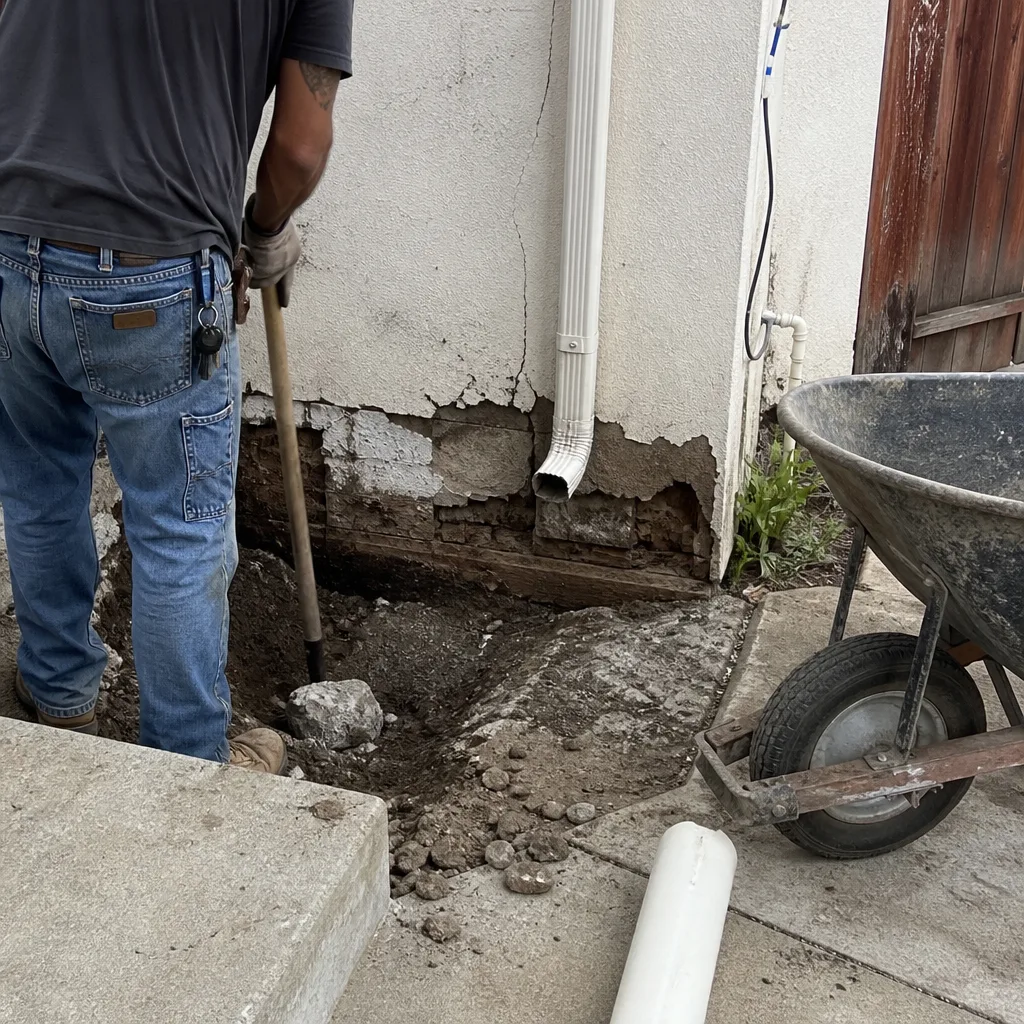 Before
 After
 Before
 After
 Before
 After
When to Call a Professional
Call a professional when a crack is wider than a dime and growing, when a door or window stops functioning rather than just dragging, when efflorescence reappears within weeks of cleaning, when a ceiling stain shows multiple rings or spreads after rain, or when the same symptom appears in multiple rooms on the same side of the house. These are system-level signals, and they deserve a system-level read. Milpitas Construction offers free estimates in Milpitas; call (877) 752-4194 and we will walk the house with you, trace the symptom to the source, and give you a written scope before you spend a dollar on repairs.
Frequently Asked Questions
The most common warning signs are diagonal cracks from door and window corners, stair-step stucco cracks, doors that stick or fail to latch, efflorescence on masonry and stucco, and ceiling stains with ring patterns. Each of these traces back to a root system: foundation movement, drainage failure, roof leaks, or water migration. Document the sign, note the season, and monitor before deciding whether the issue is cosmetic or structural.
A crack is serious if it is wider than a dime, growing over a 90-day period, appears in the same pattern in multiple rooms, or does not close during the winter wet season. Seasonal cracks that open in summer and close in winter are normal for Milpitas clay soil. Progressive cracks that do not cycle are the ones that require a professional assessment.
Milpitas sits on expansive clay soil that swells when wet and shrinks when dry. During the dry months, the soil contracts and the foundation settles slightly, opening cracks. During the rainy months, the soil swells and the cracks partially close. This seasonal cycle is normal. It becomes a problem only when the crack widens net year over year or stops cycling back.
You can inspect your roof from the attic access point by looking for daylight through the sheathing, dark streaks on the underside of the roof deck, compressed insulation lines, and cracked vent boots around plumbing penetrations. Use binoculars from the ground to check the roof surface. Do not walk a tile roof; the tiles crack easily and the fall risk is real.
Do not patch it. Document it, measure it, and watch it through one seasonal cycle if it is hairline and stable. If a crack is wider than a dime or already growing, patching without diagnosis simply hides the evidence while the structural force continues. Find the source first, then repair.
Photograph the sign with a reference object for scale, date each photo, write a one-sentence description including width and location, and repeat monthly for three months. This log gives the contractor a movement history and protects you in any warranty or disclosure conversation. Californians selling a home are required to disclose known material defects; your log turns a hazy memory into a verifiable record.
The Bottom Line
Your Milpitas house talks to you through its cracks, stains, doors, and white powder deposits. Most of what it says is specific: where the water is entering, which corner is moving, whether the movement is seasonal or progressive. Learning to read those signs before you patch a wall or replace a window is the difference between a $300 repair and a $30,000 one. Trace every symptom to its source, document what you find, and call for a system-level read when the sign is active or spreading. For ongoing education, see our more guides & resources. Milpitas Construction offers free estimates in Milpitas, and we read houses from the roofline to the slab. Call (877) 752-4194 to schedule yours.
Written by the team at Milpitas Construction, serving Milpitas since 2018.